
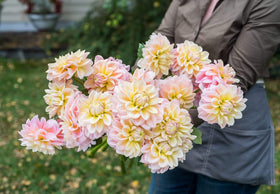

The extraordinary range of color is what draws most people to dahlias in the first place. Few flowers offer such choice: from the palest blush to deep, saturated reds, from cool lavenders to warm corals and golds. Long before questions of height, bloom size, or productivity arise, it is a particular shade that catches the eye and lingers in the imagination. Yet anyone who has grown dahlias for more than a season begins to notice something fascinating: some flowers hold their color with remarkable steadiness, while others shift subtly as the season unfolds.
Dahlia color is not so much fixed as it is environmentally responsive.
Light Changes Color More Than the Flower Does
The same dahlia can appear markedly different depending on when and where it is seen, even when the bloom itself has not changed at all.
Morning light tends to emphasize cooler undertones and finer distinctions between closely related hues. Afternoon sun intensifies warmth and saturation, often making oranges, corals, and reds appear fuller and more assertive. On overcast days, contrast softens and colors read flatter, while late-season light lends nearly everything a deeper, more restrained character.
A dahlia that reads peach in one moment may appear closer to blush or apricot in another, not because the flower is inconsistent, but because light reveals different aspects of the same pigment.
Individual Blooms Don’t Represent a Plant
It is easy to judge a dahlia’s color from a single bloom, but a plant is a sequence rather than a moment.
As the season progresses, temperature and light shifts subtly influence how a dahlia’s color reads—sometimes deepening tones, sometimes softening them. Early summer blooms may appear cleaner and brighter, while later blooms often carry more layered, complex color as nights cool and the plant matures.
In some varieties these changes are barely perceptible; in others they are part of the plant’s character. What matters is not how one bloom looks, but how the plant reads as a whole over time.
Why Color in the Garden Rarely Matches Color in Isolation
A dahlia never exists alone in the garden, and color is shaped as much by context as by pigment.
Against green foliage, certain colors assert themselves more strongly, while others recede into something softer. White flowers nearby heighten contrast, making surrounding colors appear deeper and more saturated. Dark companions—burgundy, purple, deep red—tend to pull warmth forward and cool brightness slightly back.
This is why a coral dahlia planted beside white can feel vivid and luminous, while the same coral beside plum or wine tones may appear more restrained. The flower has not changed; the visual conversation around it has.
Temperature Influences Pigment Expression
Dahlias are particularly sensitive to temperature in ways that are subtle but consistent.
Cool nights often sharpen contrast and define edges more clearly, especially in bi-colors and tipped varieties. Sustained heat can slightly soften color, sometimes muting fine distinctions or blending transitions between tones. Early fall, when days remain warm but nights cool, frequently produces some of the richest and most nuanced color of the entire season.
This is why the same variety may appear more layered in September than it did in July, even on the same plant.
Why Color Is a Season, Not a Moment
Gardeners often expect color to behave like paint: stable, controlled, repeatable.
But dahlia color behaves more like light itself—dependent on time, temperature, and context. Choosing a dahlia for color is not choosing a single shade, but choosing how that color will live and respond across a season.
Some dahlias offer remarkable constancy. Others offer variation within a recognizable range. Both are legitimate expressions of health, not signs of instability.
Why This Matters When Choosing Tubers
When gardeners are surprised by color, it is rarely because something has gone wrong.
More often, it is because a living system was expected to behave like a static one.
Understanding that dahlia color is responsive rather than fixed allows gardeners to choose with more flexibility and less frustration. A dahlia rarely offers a single color in isolation, which is why growers naturally speak in families rather than in exact shades.
Once a dahlia enters your garden, it begins a conversation with light, season, and soil that is entirely its own. What emerges may differ from what you saw in photos or a grower's fields—not in identity, but in expression—and that difference is where much of a dahlia’s beauty lives.
Thank you for the great tips. Your appreciated.
Really enjoy these articles. The one last summer, “Why aren’t the Dahlias blooming” was perfect timing.
Thank you Keith
This sentence delighted me!
The flower has not changed; the visual conversation around it has.