
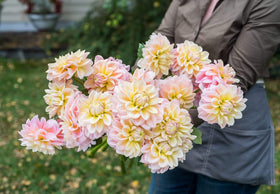

There is a moment every dahlia grower recognizes.
The first bloom opens—full, certain, almost impossibly beautiful—and the instinct is to leave it exactly where it is. To admire it on the plant for as long as possible.
Cutting it can feel wasteful, as though removing a flower must mean having less.
But dahlias do not work that way.
In fact, the opposite is usually true.
The more you cut, the more the plant produces.
What’s Actually Happening
Most gardeners already pinch their dahlias when the plants are young. That early pinch creates the first branching.
What’s talked about less is that the same principle continues all season.
Dahlias grow with a dominant tip. Left alone, that top flower receives most of the plant’s energy, and growth slows once it matures.
When you cut a long stem—removing that tip—the plant redistributes energy to the side shoots.
Those shoots lengthen.
Each becomes a stem.
Each stem sets buds.
One growing point quietly becomes several.
This is simply plant physiology: interrupt the leader, and the plant branches.
What You See in the Garden
Plants that aren’t cut often bloom in fits and starts—one or two large flowers, then a pause.
Plants that are cut regularly settle into a rhythm.
More stems.
More buds.
More usable flowers over time.
Not bigger moments—just steadier abundance.
How to Cut
Cut deeply enough to take a real stem, not just the flower head. A longer cut encourages branching lower on the plant, which creates more future stems.
And cut often. Dahlias respond best to regular harvesting.
Abundance Comes from Engagement
This isn’t about pinching—that happened weeks ago when the plants were small.
This is simply about trust.
What feels like taking is actually how the plant multiplies.
With dahlias, hesitation gives you fewer flowers.
Cutting gives you the season.