
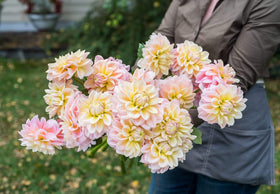

One of the first things everyone warns you about when you start growing dahlias is their floppy stems — especially the dinner plate varieties.
Every book and article seems to say the same thing: dahlias need to be staked or corralled, or they'll fall over in the first heavy rain or summer windstorm.
So people stake their dahlias snugly, because they want to be certain they're protected. The thinking goes: the less they move, the safer they are.
But when the instructions only speak to staking, a big part of the story gets missed. Like the childhood game of telephone, something gets lost as advice passes from one gardener to another. In this case, what's lost is the nature and biology of the plant.
A dahlia's hollow stem does look like an obvious weakness. Add the considerable weight of a dinner plate flower (if that's what you're planting), and it's easy to imagine the whole plant toppling in wind or rain.
But a snugly tied dahlia ignores its nature, and that creates its own problem. When a strong wind arrives, a tightly bound stem has no room to flex. The tie acts like a tourniquet, and that rigidity is what causes the stem to snap — right at the point where we thought we were protecting it.
Swaying actually helps a plant ride out a storm instead of fighting it. The plant senses the stress of wind and rain and responds to it. The process is called thigmomorphogenesis — the way a plant changes its growth in response to repeated mechanical stimulation, thickening and strengthening its stem over time. The stem isn't just enduring the weather, it's responding to the conditions it's being asked to grow in.
That's part of why a dahlia grown in an open field isn't quite the same plant as one raised in a greenhouse. Outdoors, it's continually responding to wind, rain, and the shifting weight of its own flowers. Those forces help shape the plant. There's more science behind it than that, but it's part of why we've always chosen to grow our dahlias outside.
Wiggle room is a nice place to be. When you tie a stem, leave it loose enough to allow space and movement. (Master growers often use a figure-eight knot.) A loose loop also gives the stem room to thicken as the season goes on; a tight tie that fit in June can turn restrictive by August.
The same goes for corralling. Don't pull the twine so tight that the plants are held rigidly together. Leave enough room for the stems to move before the corral catches them. A little leaning isn't failure. The plants will be fine.
At Bear Creek Farm, we no longer stake our individual dahlias, partly because we want to move quickly through the rows at harvest. We hill them instead, drawing soil up high around the base of each plant. Hilling braces the crown and lower stem and keeps the whole plant from loosening or toppling. It also buries weeds, so we're not spending time with that task. The mounded soil also acts like a mulch. Unlike a tie, it leaves the upper growth completely free to move with the weather.
So next time you're staking, think about all of it. A dahlia doesn't need to be held still. It needs room to move — just like the rest of us do, out here in the weather.
If you spray dahlias with regular yogurt, 1 cup per gallon of water, the calcium will make the stems stronger and it will also prevent powdery mildew. The are cheaper forms of foliar calcium if you have a lot of plants. Silica also makes stronger stems.
Thanks so much! We started using hortanova netting last year for our community garden dahlia bed. 2 layers. This year we’ve used only one layer. I put stakes in to mark the tuber placements initially, but don’t tie main stem to stake. Honestly, I am finding that pinching back, Chelsea Chop, and/or debudding may be the best way to go in the future. One can better control the spread and get stronger plants & larger blooms, while the plants support each other. I’m also a great believer in airflow as preventer of all sorts of diseases. BTW do zinnias also. benefit from swaying in the breezes?? Thanks again. Excellent blog.
Really good information- thanks!
Really good information- thanks!
As a person that is pretty new to dahlias and literally just started staking them this year. I learned the hard way about loosening the tie. My stalk broke at the place I tied it, it weakened the stem. So I went around to every dahlia that I had staked and loosened all of them.