

When people think about growing better dahlias, they usually think about the flowers. We think about the stems.
During the growing season, while everyone is waiting for the flowers, we spend an inordinate amount of time looking at the stems.
There is a reason.
A beautiful dahlia on a poor stem isn't a particularly good flower. It may not last long once cut and it could likely droop in the vase, making it difficult to arrange.
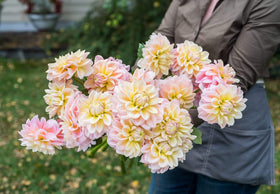
So long before we're thinking about the flower, we're thinking about the health of the stem. More than the health, we are also thinking of its strength and beauty. We seek, long, straight, relatively slender stems that are elegant but remarkably strong. Our best stems can almost feel like steel.
The interesting part is that strength doesn't necessarily come from making a stem bigger. It comes from how the stem is built. So we look to nature about how to build an architectural foundation that is not only strong but as pretty as the flower above it.
A Plant Builds for the World it Lives in
Dahlia strength comes from cellulose and lignin making up much of the main structural framework of its hollow stem. If a young plant is grown in a perfectly still, completely protected environment—like a greenhouse, an indoor grow room, or tightly strapped to a rigid stake where it never moves—it misses out on a vital natural trigger: mechanical stimulation. That stimulation builds more lignin, another vital part of the stem's structural framework.
Lignin gives a stem its bend — the same give you'd feel in a slender fiberglass fishing rod. Without it, a plant is left with just a thick, fleshy stem: bulk without spring.
Wind is part of the story. When a young stem moves repeatedly in the breeze, the plant senses that mechanical stress and changes the way it grows. More lignin is produced and stems have flex, which is why we recommend not staking tightly.
Don't Feed for Size
You can directly control whether your plant builds cellulose or lignin by adjusting its nutrient balance. But before thinking about adjusting fertilizer, it is important to test your soil. Though healthy stems and long-lasting flowers are important, the appearance of a stem may not be as important to everyone as it is to us at Bear Creek Farm.
Nitrogen helps with fast, leafy growth, which is helpful early on but can work against you later, when what the plant needs is structure rather than more growth. Dahlias need it, particularly while they are establishing themselves. But once a plant is large and growing vigorously, nitrogen can give you an abundance of leaves, tall, thick stems and lush growth when that isn't what you're trying to produce.
Potassium tends to encourage density over size by being involved in water regulation and the movement of sugars through the plant. Calcium plays a supporting role holding cell walls firm from the inside.
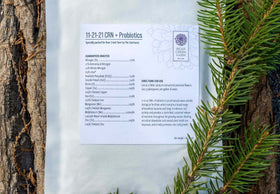
This is a way to look at fertilizer differently depending on season shifts and what the plant is telling you. It's not one formula. None of it is a recipe to follow blindly. It's context for a conversation you can only have once you know what your own soil is giving your dahlias. Test your soil. If the soil already contains what the plant needs, adding more isn't better. If you do fertilize, keep potassium higher than nitrogen.
A Gentler Kind of Pinch
We also think about the shape of the plant early.
Pinching removes the dominant growing tip and encourages buds below it to develop into lateral branches. That gives us multiple flowering stems rather than one central stem continuing upward.
There's a lot of leeway here because you can pinch a plant anywhere from 12" to 18", depending on your timing. You shouldn't have anxiety. However, early pinches can help produce more slender stems. Pinching early encourages four to six slender side branches instead of two or three thicker ones — the plant's effort spread wide instead of concentrated.
Do You Disbud?
As a commercial farm with many acres and acres of dahlias, as much as we would like, we do not often disbud, but when we do, we think about the stems.
A dahlia normally produces a central bud with two smaller buds beside it. Seeking one showpiece bloom, some gardeners remove every side shoot so all the plant's energy funnels into the main flower. But the timing can make a difference. If you don't remove those side shoot buds until they are the size of a marble, it gives the stem somewhere else to send a little of its energy in those early weeks. This helps it from thickening the way it might if the main stem were carrying the single main flower alone.
There isn't one intervention that produces the kind of slender, strong dahlia stem we seek. It's the accumulation of decisions made throughout the season. Letting stems flex in the wind without stiff ties, the fertilizer we hold back or moderate, pinching or the occasional disbud.
For us, the stem has become part of the beauty of the dahlia itself. The longer we grow something, the more there is to observe and respect.