
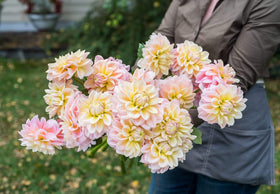


There is something a little curious about the way peonies behave in the cultural imagination. They are treated as the aristocrats of the garden—luxurious, fleeting, extravagant—yet almost no one talks about the fact that peonies are, in many ways, profoundly practical flowers.
Not practical in the modern sense of efficiency. Practical in the older sense: enduring, useful, resilient, built to accompany a life.
A peony plant can outlive the gardener who planted it. Entire family lines have inherited them without planning to. Old farmhouses disappear; lilacs go wild; fences collapse; and still, in late spring, a circle of peonies rises in a place as if memory itself had roots.
This is one of the more unusual things about peonies: they belong equally to luxury and permanence.
Most flowers associated with opulence are transient by nature. Hothouse orchids. Forced tulips. Rare roses that require endless intervention. Peonies are different. Once established, they can persist for decades with surprisingly little drama. The bloom itself may look extravagant, but the plant underneath behaves more like an old fruit tree than a diva.
And perhaps that is part of why people respond to them so deeply.
They offer abundance without frenzy.
A mature peony does not bloom cautiously. It commits. The plant spends nearly an entire year storing energy underground for a single spectacular moment in late spring. Then, almost overnight, the garden changes character completely. The blooms are so oversized and lavishly layered that they alter scale around them. A small path suddenly feels romantic. A kitchen table begins to look cinematic. Even one stem in a jar has the visual weight of an arrangement.
Which is partly why a late frost can feel so dramatic. This year, many peonies were touched just as they prepared to open—buds singed overnight, outer petals browned, many flowers lost altogether. And yet the plants themselves continued forward almost matter-of-factly, sending up fresh growth, strengthening their stems, and continuing their steady ascent into the season.
There is something revealing in that distinction. The flower may be fleeting. The plant is not fragile.
Perhaps this is also why difficult seasons so often become the most educational ones. You begin to see the peony not merely at its peak, but in negotiation with weather, timing, resilience, and recovery. The garden becomes less of a showroom and more of a living conversation.
And still, despite spring’s interruptions, the sense of abundance remains.
Peony stems transport enormous amounts of water in a very short blooming window. Their buds are protected by a sugary sap that gardeners refer to as “ant nectar,” though the ants themselves are mostly incidental visitors rather than essential partners. The petals unfold through hydraulic pressure and temperature shifts so rapidly that on warm days you can almost feel the flower moving toward fullness by the hour.
And then there is their fragrance, which may be one of the least understood elements of all.
People speak of peonies as though they have a singular scent. They do not. Some smell distinctly of rose. Others of citrus. Some have notes that verge on spice or fresh linen. A few heirloom whites carry a faint lemon-cream quality that delicately hovers like a cloud.
Perhaps the strangest thing of all is how brief their season remains despite centuries of human obsession with them.
We have manipulated roses into endless bloomers. We have engineered tulips into impossible forms. Yet peonies still retain a certain refusal. Their season comes, swells, and disappears with startling speed. Even commercial growers cannot entirely bend them to convenience without losing something essential in the process.
And maybe that is why people wait for them with such emotion.
Not because they are rare.
Because they still resist becoming ordinary.
“They offer abundance without frenzy.” I love how you write, and how you love what you write about.
Beautifully written homage to a beautiful plant and flower. They definitely have caught my attention and are worth the work and the practice of patience with them.
I look forward every spring to my peonies blooming and this spring has not been disappointing-they are gorgeous! I, too, love them.
I have peonies that my great grandmother planted. They went from the farm to my parents house and have been with me now 30 years. Loved your post on the blog!
I love them! I have one that is huge and pink. My dog can run over them and they survive very well. I put 5 in last year and they are all doing well. They fill up my garden so well. I did see some browning on the leaves a bit due to a frost but they still opened up. Love em!