
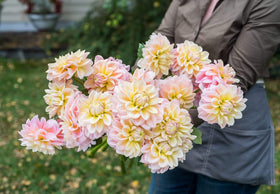


Much of how we talk about flowers is often shaped by images of abundance—beds filled edge to edge, plants growing shoulder to shoulder, color everywhere at once. It’s an appealing picture, and for many flowers it works beautifully.
Dahlias, however, ask for a slightly different way of thinking. They are large, fast-growing plants with extensive root systems and substantial leaf mass. From the first weeks of above ground growth, they are competing for light, air, and moisture. How much room they are given influences how efficiently they can do that work—and how steadily they can keep doing it over the course of the season.
Spacing is one of the least talked-about decisions in growing dahlias, even though it influences things that are easy to blame on other causes: floppiness, uneven flowering, or the feeling that a plant is “fine, but not quite what I had hoped.”
What Space Means to a Dahlia
Dahlias grow quickly, but they are long-season plants. They are asked to build roots, stems, foliage, and flowers at the same time—and then repeat flowering again and again over many weeks.
This is one reason spacing advice for dahlias varies so widely. Depending on the source, gardeners may see recommendations anywhere from 9 inches to 24 inches, often without explanation of what those differences are meant to support.
When a dahlia has adequate space, growth tends to distribute more evenly through the plant. The plant is better able to hold itself as it gets taller and begins carrying heavier foliage and blooms.
When space is tighter, the plant adjusts. It still grows. It still blooms. But the balance shifts: growth tends to reach upward and outward more aggressively, and the plant may require more support and attention as the season progresses.
Neither approach is wrong. They simply lead to different experiences.
Why This Often Goes Unnoticed
Spacing is decided once, at planting, long before there’s anything to respond to. Early growth rarely signals what’s coming. Beds fill in quickly. Everything looks promising.
It’s later—mid-summer, during periods of fast growth, heat, or heavy rain—that spacing reveals itself. The effects aren’t dramatic enough to feel like mistakes. They show up instead as subtler impressions: how upright the plants remain, how easy the bed feels to move through, how straightforward it is to cut clean stems, whether bottom leaves need to be removed, and how well the planting holds its shape over time.
Because those impressions arrive gradually, spacing is rarely identified as the underlying cause.
A More Helpful Way to Think About It
Rather than thinking of spacing as a rule to follow, it’s more useful to think of it as a way of choosing the pace of your garden.
Closer planting creates immediacy because foliage meets sooner, beds fill quickly, and flowers read as a concentrated mass early in the season.
More room creates continuity because each plant has more consistent access to light, air, and moisture as it matures, which often supports steadier performance over a longer stretch of weeks.
Both approaches can be successful. What changes is not whether dahlias bloom, but how the season tends to unfold.
What Space Actually Changes
Spacing doesn’t determine whether a dahlia will grow. It shapes how the plant behaves once it is growing—how it builds structure, how it supports itself, and how consistent it is over time.
When plants are given more room, a few things generally become easier. Light reaches deeper into the plant rather than only the outer canopy. Air moves through foliage more readily. Watering is easier to gauge because fewer plants are drawing from the same footprint. Stems are less likely to tangle or lean into one another as plants expand.
When spacing is tighter, none of these processes stop—but the margin for error narrows. A beautiful season is still entirely possible. It simply requires more attentiveness to canopy density, airflow, and physical support as plants grow larger and heavier.
Some gardeners enjoy the fullness of a densely planted bed. Others prefer a planting that remains more open and legible as the season progresses. Dahlias can accommodate both—but they respond differently to each. Knowing that ahead of time often makes the season feel less surprising, and more satisfying.
A Note From the Farm
At the farm, we don’t rely on a single spacing rule. We space different varieties differently, based on what we’ve learned about how each one grows over a season, always aiming to give each plant sufficient room rather than crowding it into a fixed formula.
Home gardens don’t need to follow that level of nuance—but the principle translates: more space generally means a plant that manages itself more easily, while closer spacing often asks for more active support and attention as the season progresses.
Why This Matters When Choosing Tubers
Buying dahlia tubers is an act of anticipation. You’re not just choosing color or form; you’re choosing how a plant will occupy space in your garden for months.
Thinking about spacing at the moment of choosing doesn’t limit what you can grow. It clarifies what each plant will need in order to perform well alongside the others—and alongside your time, attention, and tolerance for intervention. Dahlias tend to respond generously when those conditions are considered early.
In the End
This isn’t about planting less, or planting more. It’s about understanding that spacing isn’t a technical footnote—it’s one of the early decisions that reliably shows up later as ease, or as extra work.
When spacing is treated as a tool rather than a rule, dahlias become easier to read, easier to manage, and more consistent in what they give back. And consistency - more than perfection—is what brings people back to dahlias year after year.
Nicely written article about spacing. It’s so overlooked. I’ve learned much from trial & error in my almost 20 years of growing dahlias & still learning. Thanks.
Thank you so much – I tried to space my rows too close together last year and even though had supports for each one – it was extremely difficult to move through and I couldn’t understand why so many stems just flopped over and/or I was breaking them off – now I understand. Definitely considering a different plan this year.
I love this post. And it makes me want more detail. Could you please consider this a two-part post, and in Part B. provide concrete examples of Dahlias and how you spaced them and why. I am just mapping out my varieties, taking into account height, blossom size, profilic or not. I’d love to learn from you.
This is a great piece of advice. What do you recommend for planting pots from 7-24 Gallon?
Thank You
Jerry
This is one of the best write ups I have read in a long time. Thank you so much for this work. Keep up your excellence.